

These Macro Photos of Snowflakes Reveal Nature’s Most Dazzling Designs

:max_bytes(150000):strip_icc():format(jpeg)/macro-snowflakes-2b46d901274c449da5dc165cd9033907.jpg)
It’s easy to be swept up in awe when taking in an expansive landscape or a sky blazing with sunset-pink ripples. But nature’s tiniest designs can be just as transformative. Take snowflakes. Their shape is an iconic theme in winter décor, but behind their cheery form lies some of Mother Nature’s most magical work.
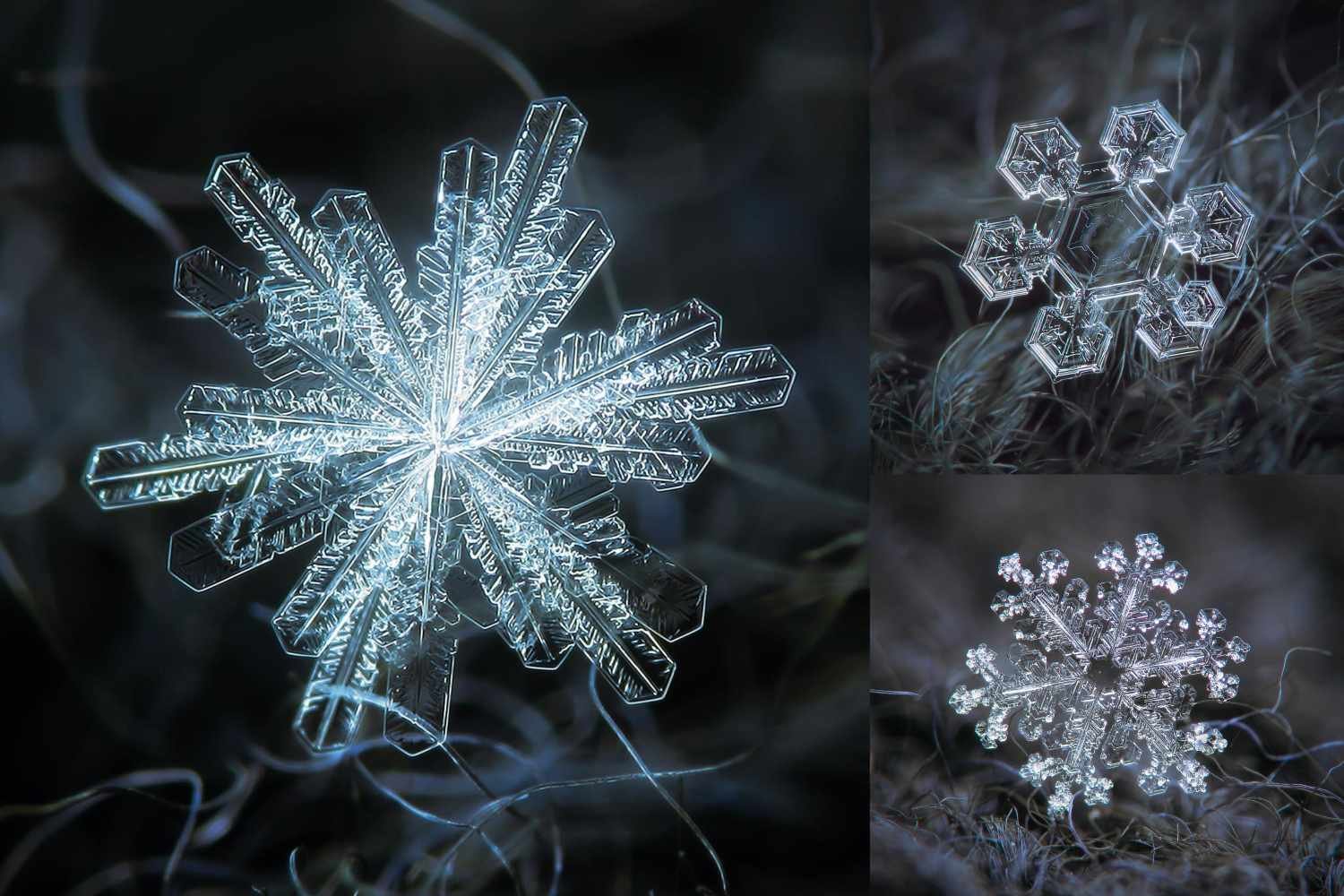
Snowflakes appear in dozens of structures, from simple columns and stars to ornate dendrites and beyond. Ahead, we’ve gathered a selection of macro photographs of classic snowflake forms to show just how remarkable these tiny wonders truly are.
Credit:
ChaoticMind75 / Getty Images
These exquisite photos were taken by Alexey Kljatov, a photographer from Moscow. “My passion is taking macro photos of real snowflakes,” he writes on his website. “Natural snow crystals, due to their beauty, amazing shapes, structures, uniqueness, and endless variety, are one of the most interesting subjects for macro photography.”
Credit:
ChaoticMind75 / Getty Images
Snowflakes are born when a supercooled water droplet freezes onto a particle of dust or pollen in the sky, forming an ice crystal. As the crystal descends, more water vapor freezes onto its surface, building new structures—these become the six arms of a snowflake.
Credit:
ChaoticMind75 / Getty Images
“The ice crystals that make up snowflakes are symmetrical (or patterned) because they reflect the internal order of the crystal’s water molecules as they arrange themselves in predetermined spaces (known as crystallization) to form a six-sided snowflake,” explains the National Oceanic and Atmospheric Administration (NOAA).
Credit:
ChaoticMind75 / Getty Images
The shape a snow crystal takes is guided by temperature—and, to a lesser degree, the moisture in the air.
Credit:
ChaoticMind75 / Getty Images
At around 23 degrees Fahrenheit, crystals grow long and slender, forming needle-like shapes. Drop the temperature to about 5 degrees, and those same crystals spread outward instead, becoming thin, flat plates.
Credit:
ChaoticMind75 / Getty Images
A crystal may begin growing its arms in one pattern, only to shift course moments (or seconds) later as subtle changes in temperature or humidity alter the way ice forms, NOAA explains. No journey is the same, which is why no two snowflakes are alike.
Credit:
ChaoticMind75 / Getty Images
Although the ice crystal will always have six sides, the arms can branch off in new directions—but since each arm travels through the same atmospheric conditions, they form in identical patterns. (Sometimes two snowflakes team up when forming or extra growth is layered onto the same six-armed framework, giving the appearance of 12 arms.)
Credit:
ChaoticMind75 / Getty Images
Snowflakes can also take on shapes that veer from the classic star shapes. Column and needle forms still have six sides, since this occurs at the molecular level as ice crystals form in a hexagonal lattice. But column-shaped crystals grow lengthwise instead of outward into arms.
Credit:
ChaoticMind75 / Getty Images
Kljatov explains that he photographs the snowflakes on a balcony at his house. Many are on a glass surface, but the photos of bright snowflakes on dark backgrounds, like the ones shown here, are shot on black woolen fabric using the natural light of a cloudy sky.
Credit:
ChaoticMind75 / Getty Images
While each of these snowflakes existed for just a moment, thanks to a patient eye and a bit of winter light, we have the chance to study their fleeting intricacy. And now, the next time you notice a snowflake on your sleeve, you can take a closer look and marvel at its seemingly impossible design.